

Tool
UPL Guidance Document
The UPL Guidance Document provides detailed guidance on how to apply the UPL best practices.
Below is a sample of detailed guidance related to Empower Caregivers:
- Recognize that caregivers may be spouses, partners, parents, adult children, siblings, friends, neighbors, chosen family, faith-community members, young (or youth) caregivers, or distance caregivers.
- Use caregiver terminology that reflects the audience and context. Terms may resonate differently across communities, cultures, and disease areas.
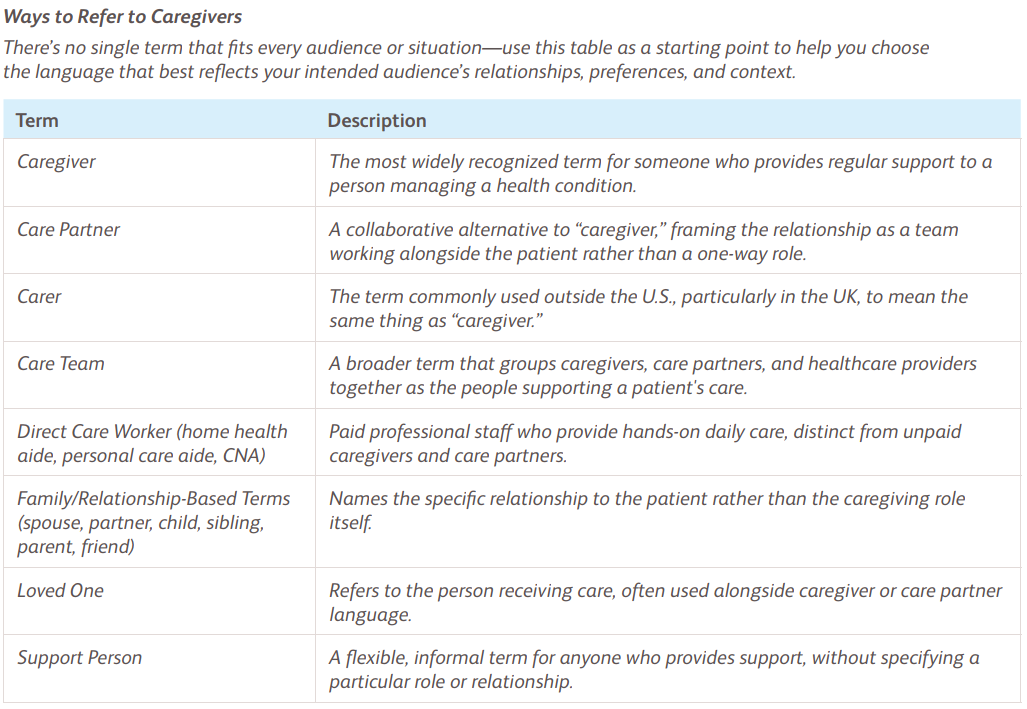
- Avoid assuming every caregiver has the same role, responsibilities, decision-making authority, available support, or capacity to provide care.
- For example, a spouse who helps make healthcare decisions may have a very different role from a friend who provides transportation or a family member who manages medications from a distance.
- Recognize that caregivers may also be caring for other people or managing responsibilities outside this particular care experience.
- Acknowledge that a caregiver’s own health and wellbeing affect their ability to care for someone else.
- Normalize taking breaks, accepting help, and using available support services.
- Offer realistic, flexible suggestions rather than creating additional expectations or obligations.
e.g., Instead of “Make sure you take time for yourself every day,” say, “When you’re able to, even a few minutes to step outside, stretch, or connect with someone you trust can help you recharge.” - Adapt wellbeing guidance to the caregiver’s circumstances, including their available time, support, health literacy, and access to care.
- When a communication is intended for caregivers, address them directly (“you”) and write from their perspective rather than only embedding caregiver information within patient-facing content.
- State clearly who the communication is for and what it will help caregivers understand or do.
e.g., “This guide is for caregivers, or those who provide care for a patient. It will help you recognize symptoms, respond in the moment, prepare for conversations with the care team, and care for yourself.” - Use language that helps people recognize when the communication applies to them, even if they do not identify with the term “caregiver.”
e.g., Instead of saying, “If you are a caregiver...,” say, “If you help a family member or friend manage appointments, medications, or daily care...” so people can recognize that the information applies to them even if they do not identify as caregivers. - Recognize caregivers as individuals with their own questions, responsibilities, and information needs—not solely as an extension of the patient.