CASE STUDY
Redesigning How We Communicate Drug Safety Information

WHY IS THIS IMPORTANT?
Drug safety information is very important for patients, as it communicates to them the benefits and risks of a drug. It’s also one of the most common patient communications produced by any pharmaceutical company.
Our Challenge
Traditionally, drug safety information is developed with a relatively fixed, text-only template.
Drug safety information is essential for helping patients understand the benefits and risks of a medication. But it is also created under specific FDA guidance and is usually presented in a dense, text-only format with heavy medical language.
Our goal was to use the UPL to redesign this information so it would be more inviting for patients to read and easier to understand—while still working within regulatory requirements.


Applying the UPL
Core UPL Tools can guide communication creation or redesign when feedback is available.
If possible, it is always important to get stakeholder feedback—whether from the customers or patients you serve, advocacy organizations in your space, or internal employees—to understand gaps and opportunities. We realize, though, that this is not always possible. If we cannot get direct patient feedback, we go directly to the UPL tools.
In this example, we would leverage:

Our Output
We focused on a visual approach grounded in patient needs.
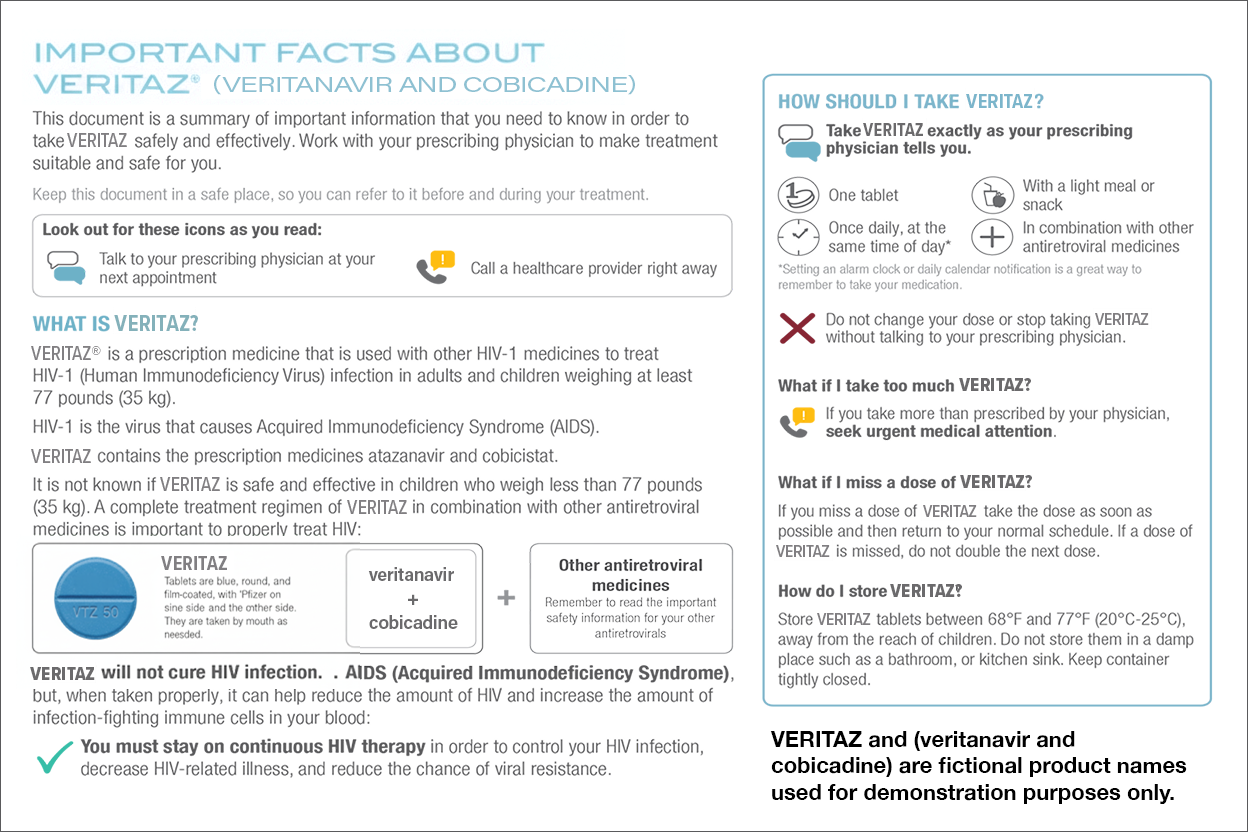
To change the text-only approach, our new drug safety information is much more visual. We focused on icons and white spaces, as well as simpler language. We also added more information based on what patients told us was important to them which included adding in how often side effects were observed in the clinical trial and more detail on how to take the medication.
Communicate Visually
We introduced standard icons to help patients quickly identify when to talk to a doctor or call their healthcare provider, along with other key actions.
Demonstrate Empathy
We highlighted moments that encourage conversations with the patient’s doctor—reinforcing the patient-provider relationship.

